At a glance: the Gulf of Saint-Florent
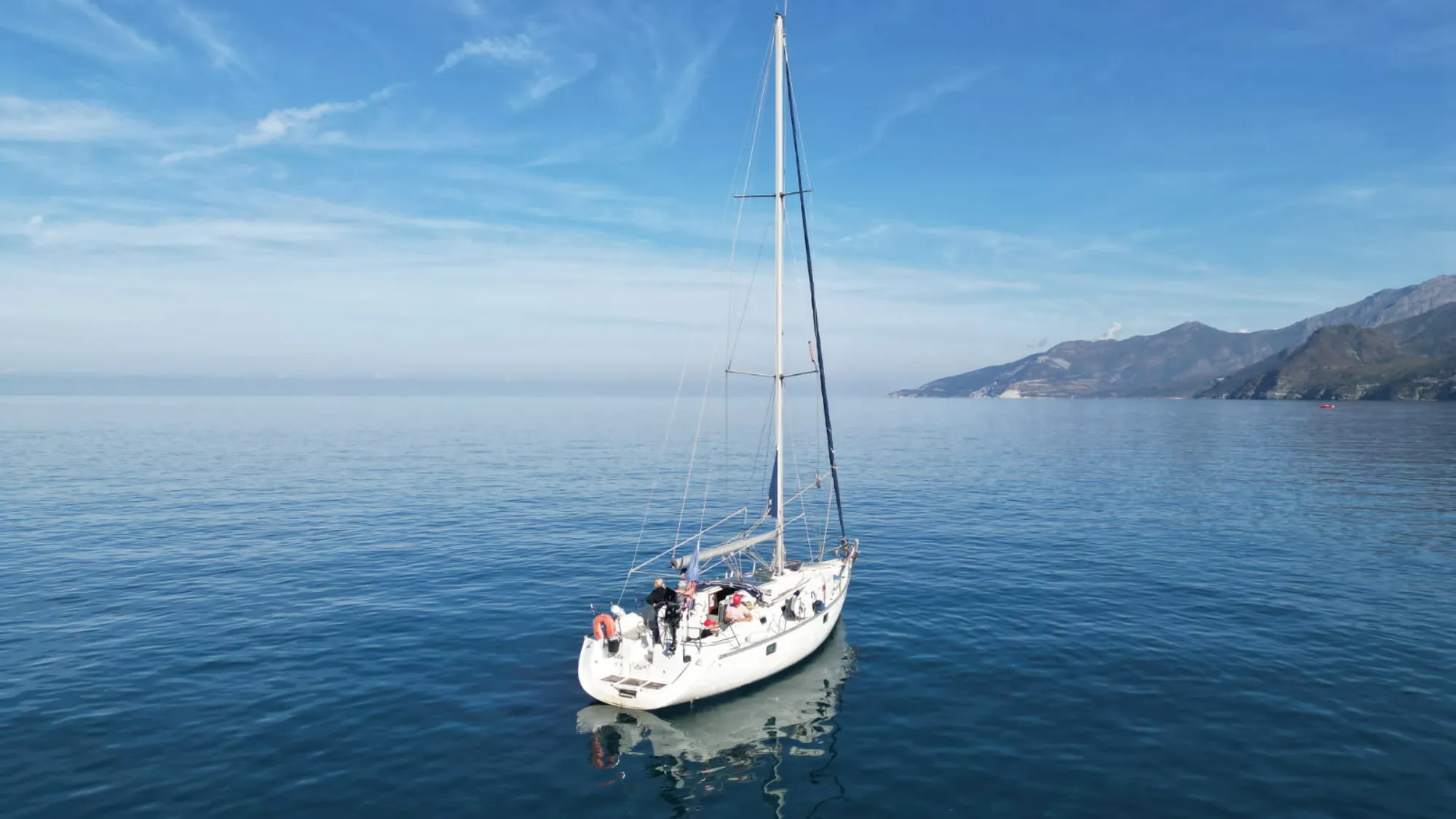
The Gulf of Saint-Florent is a gentle bay in northern Corsica, wedged between the steep Cap Corse peninsula to the east and the Agriates desert to the west. Fifteen kilometres long, four deep, it shelters a port village with a distinctive atmosphere, a wine region classified AOP Patrimonio since 1968, a Genoese tower steeped in military history, and several discreet beaches you only find if you know where to look.
A modest fishing and trading port for most of its history, Saint-Florent turned a corner in the 1970s and 1980s as leisure yachting arrived. Today a village of 1,500 year-round inhabitants swelling past 10,000 in August, it has never lost its Corsican identity: dawn fishermen and afternoon sailors share the same quay, apéritifs run long on the terraces, and the circular 15th-century citadel still commands the harbour.
This guide covers what matters before you arrive: the village’s Genoese history, the nautical geography of the gulf, the Tower of Mortella episode, the Cap Corse villages visible from the sea, Nonza and its black pebbles, the Patrimonio wine region, the best gastronomic addresses, and the right season to come.
History: from Genoese port to ‘little Saint-Tropez’
Saint-Florent owes its existence to the Genoese. In the 15th century, the maritime republic of Genoa — then administrator of Corsica — built a circular citadel at the natural mouth of the gulf to watch over access to the Balagne and the inland Nebbiu. This fortress, remodelled several times, still dominates the harbour today and has housed a museum of village history since 2019.
The village then organised itself around the port: narrow streets, tall houses with coloured façades, a central square pressed against the quay. Disputed several times between Genoa, France and the Papal States — Saint-Florent briefly featured among papal possessions in the 16th century — it passed definitively under French administration in 1768 when Corsica was ceded to France.
A modest fishing and trading port for centuries, Saint-Florent turned a corner in the 1970s-1980s with the arrival of leisure sailing. The modern marina, inaugurated in 1985, grew from 120 to 750 berths in three decades. The comparison with Saint-Tropez emerged in the specialist press and has long irritated locals: Saint-Florent is infinitely calmer, less crowded, more authentic. What it shares with its Provençal counterpart is that particular atmosphere — terraces facing the sea, ice creams eaten quayside, dinners running to midnight without pretension.
Timeline
Saint-Florent through the centuries
-
Foundation of the Genoese citadel
The Republic of Genoa builds a circular citadel at the mouth of the gulf to watch over access to the Balagne and the Nebbiu. It still dominates the harbour today.
-
Construction of the Tower of Mortella
The Genoese build a watchtower at the southern point of the gulf, part of a coastal surveillance network that would eventually count more than 85 towers around Corsica.
-
Corsica ceded to France
By the Treaty of Versailles, the Republic of Genoa cedes Corsica to France. Saint-Florent passes under French administration after more than three centuries of Genoese rule.
-
Nelson's siege of the Tower of Mortella
British Admiral Horatio Nelson attacks the tower with frigates HMS Juno and HMS Fortitude. The 38 French defenders hold out for three days. The British Admiralty, deeply impressed, would copy the tower: the Martello towers of the British Empire take their name from the Corsican Mortella.
-
AOP Patrimonio recognition
The Patrimonio wine region obtains Corsica's first wine AOP, recognised for its schist terroirs and native grape varieties (niellucciu, vermentinu, muscat petits grains).
-
Rise of leisure yachting
The modern marina opens (1985) and quayside restaurants follow. The 'little Saint-Tropez' label appears in the national press. The village grows from 800 to 1,500 permanent residents.
-
Cap Corse and Agriate Marine Nature Park
France's 9th marine park is created by decree, encompassing the waters of the Gulf of Saint-Florent, the Cap Corse and the Agriates. A 6,830 km² zone is now protected.
Geography & sailing: why the gulf is an ideal shelter
The Gulf of Saint-Florent is an almost ideal sailing shelter. Open to the north-west, it is protected from the dominant winds (north-west mistral, north tramontane) by the bulk of the Cap Corse, which rises to 1,307 m at Monte Stello. This natural shelter made it a military and commercial port from antiquity: the Romans maintained a trading post here, traces of which still emerge south of the village near the Romanesque cathedral of Santa Maria Assunta (12th century).
The gulf seabed shelves gently along the southern shore (Roya beach, progressive depth) and more steeply along the northern shore (schist cliffs around Mortella). This asymmetry is typical of Corsican gulfs: schist to the north, granite and pale sand to the south. The coastline varies over twelve kilometres between clear sand beaches, intimate coves, pink granite cliffs and ruined Genoese towers.
The D81 coast road connecting Saint-Florent to Nonza only runs along a portion of the shoreline — some seven kilometres between Patrimonio and Farinole. To see the rest — the white cliffs above Nonza, the wild coast between Pino and Centuri — you must take to the sea. This is also true of the Tower of Mortella and the entire west coast of the Cap Corse, reachable from land only at the cost of long walks or impractical roads.
The Tower of Mortella: sentinel that inspired the British Crown
Built by the Genoese in 1563 at the southern point of the gulf, the Tower of Mortella is one of Corsica’s most famous. Not for its silhouette — all Genoese towers look broadly alike, a 10-metre circular base, 4 metres of wall thickness, three levels — but for what happened there in 1794.
That year, during the French Revolution, a small French garrison of 38 men defended the tower against a British assault launched from two frigates, the HMS Juno (32 guns) and HMS Fortitude (74 guns), under the command of Admiral Horatio Nelson. Despite overwhelming numerical superiority, the defenders inflicted heavy losses on the British fleet: 67 British killed and wounded against two French dead. The tower eventually fell, but the episode made a profound impression in Great Britain.
The siege of 1794
When Nelson inspired the Royal Navy
The British Admiralty, impressed by the Corsican tower’s resistance, conducted a detailed architectural study. Between 1804 and 1812, during the Napoleonic Wars and the threat of French invasion, it commissioned the construction of 103 coastal defence towers on the Corsican model: along the coasts of Kent, Sussex, Ireland, then in the colonies (Canada, South Africa, Jamaica, Menorca).
The name, corrupted from ‘Mortella’ to ‘Martello’ by a British intelligence officer’s transcription error, stuck. Each Martello tower faithfully reproduces the original: three levels, thick walls on the seaward side, a firing platform on top with a central pivot for a single cannon.
Around fifty survive today, some converted into museums, others into private homes. The original tower, in Saint-Florent, is partially ruined — its summit was blown off by British shelling during the siege — but remains perfectly recognisable. It is only reachable on foot via a difficult path or, far more simply, from the sea during a sailing trip.
The Cap Corse villages from the sea
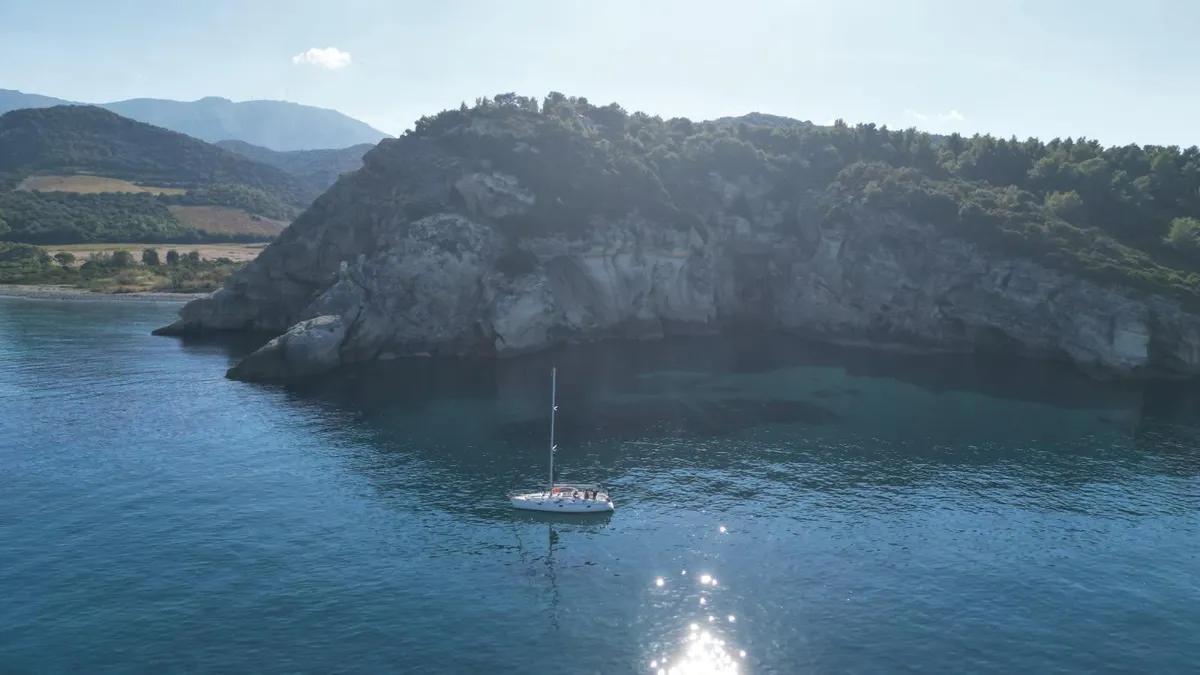
The Cap Corse, the rocky peninsula 40 km long and 12 km wide pointing north from the rest of Corsica, offers a succession of cliff-hanging villages, each with its own character. Seen from land, they require hours of switchback driving — the D80 coast road counts over 400 turns across 120 kilometres. Seen from the sea, they line up within two hours of gentle sailing.
Patrimonio opens the wine route (see below). Farinole keeps its hamlet feel, a half-ruined Genoese tower planted on a spur. Nonza — which we treat separately given its silhouette deserves a dedicated chapter — appears suddenly as the yacht rounds a headland. Further north, Pino preserves the finest 19th-century shipowner houses, those palazzi di lusso built by Cap-Corsins grown wealthy from trade with the West Indies and Latin America. Canari and its baroque church Santa Maria Assunta dominate the village entrance. Centuri shelters one of the last lobster-fishing harbours in the Mediterranean — the catch still lands each morning in season. Macinaggio finally opens onto the Finocchiarola islands nature reserve, three rocky islets sheltering a colony of Audouin’s gulls (rare in the Mediterranean) and a particularly discreet common tern.
Nonza and its black pebbles: the Cap Corse signature village
Nonza is the postcard village of the Cap Corse. Perched on a 100-metre granite spur dropping sheer into the sea, it is crowned by the square silhouette of an 18th-century Paolian tower built during the brief independent kingdom of Pasquale Paoli (1755-1769). At the foot of the cliff, the beach extends for over a kilometre of black pebbles with metallic reflections in the sunlight — an anomaly that startles anyone familiar with white Mediterranean sands.
Industrial geology
Why are the pebbles black?
The original beach was composed of pale pebbles like most Cap Corse beaches. But between 1948 and 1965, an asbestos mine operated above the village, in the neighbouring commune of Canari. Mining waste, discharged into the sea over the cliff, gradually covered the original beach and gave it its distinctive dark colour.
The site was remediated in the 2000s and asbestos is now bound into the rock with no inhalation risk. Swimming is safe, tested regularly by the regional health agency. The seabed, meanwhile, remains crystal-clear: granite blocks between which dusky groupers, corb and sea breams move — one of Northern Corsica’s most sought-after sites for snorkelling and scuba diving.
From the sea, the view of the village and its tower is one of Northern Corsica’s most arresting tableaux. Our Cap Corse — Nonza day cruise brings the yacht within 50 metres of the cliff face for an anchoring and swim session in front of the village, in 15 metres of transparent water.
Beaches of the gulf: where to swim in Saint-Florent
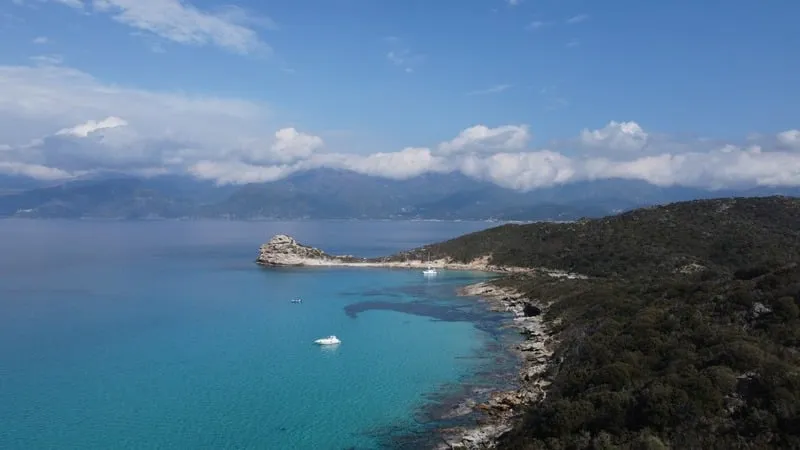
Ten minutes on foot from the harbour, Roya beach unrolls its kilometre and a half of clear sand, fringed by a shaded promenade of tamarisks and eucalyptus. This is Saint-Florent’s family beach: long, shallow near the shore (two metres at ten metres out), equipped with seasonal beach bars, and accessible for persons with reduced mobility via a wooden ramp. It is also the starting point of the coastal path to the Agriates — 4h30 on foot to Lotu.
A little further north, reachable by car via the D81 then a five-minute footpath, Olzo beach is shorter (500 metres), wilder, with low vegetation of samphire and juniper providing natural shade. This is the locals’ beach, a refuge from August crowds at Roya.
Tettola beach, right next to Olzo, is the better-kept secret: a small sand-and-pebble cove with rocky seabed ideal for snorkelling. You can regularly spot gilt-head sea bream, juvenile groupers and, on lucky days, a moray eel tucked into a crevice. No beach bar, no amenities, just the gentle clap of waves.
For the more mythic Saleccia, Lotu and Ghignu beaches — all three outside the gulf, on the Agriates side — we refer you to our dedicated pillar guide: The Agriates Desert: beaches, history and access.
AOP Patrimonio: Corsica’s oldest wine appellation
Just ten minutes’ drive from the port of Saint-Florent, the Patrimonio wine region extends over 9 communes and 420 hectares of south-west-facing hillside. It is Corsica’s first wine AOP, recognised in 1968 — nine years ahead of the other Corsican AOPs. Terroirs are exclusively limestone, which is rare in Corsica (the island is overwhelmingly granitic) and gives the wines a minerality and freshness seldom found elsewhere on the island.
Grape varieties are strictly native:
- Niellucciu (red): historic Corsican variety, related to Tuscan sangiovese — 80% of Patrimonio red plantings. Structured, spicy wines, good for ageing (5 to 10 years).
- Vermentinu (white, also known as malvoisie of Corsica): Mediterranean variety also grown in Sardinia and Provence (where it’s called rolle). Dry, aromatic wines with citrus and maquis notes, ideal with the gulf’s fish.
- Muscat petits grains (white, naturally sweet wine): the Muscat du Cap Corse AOP, intensely aromatic, served as an aperitif or with brocciu desserts.
Notable estates
Among the must-visit estates for a tasting:
- Antoine Arena (Patrimonio village): Corsican biodynamic pioneer, alive and precise wines, book several weeks ahead.
- Orenga de Gaffory (Patrimonio): a historic 18th-century cellar, broad range, tasting in a fine vaulted room.
- Clos Teddi (Poggio-d’Oletta): signature gulf rosés, relaxed atmosphere, exceptional view over the gulf.
- Yves Leccia (Poggio-d’Oletta): remarkable technical precision, wines of great aromatic purity.
- Domaine Gentile (Patrimonio): one of the oldest estates, old niellucciu vines, reds built to age.
- Domaine Giudicelli (Patrimonio): organic since 2003, natural vinifications, small-batch cuvées.
Most welcome visitors for free tastings, often by appointment in season. Allow 1h30 to 2h per estate if you want to really understand — Corsican winemakers are talkative when someone is interested.
Producers and where to eat around the gulf
Around the Gulf of Saint-Florent, producers work within the short-supply-chain logic rooted in the Corsican tradition where, until the 1970s, most consumption came from within a 20-kilometre radius. The Saint-Florent covered market, open mornings in season (May to October), gathers butchers, cheesemakers, greengrocers and fishmongers in a concentrated space — ideal for assembling a picnic or simply observing local life. Out of season, it becomes a weekly Friday-morning market.
Charcuterie: The Colombu family in Poggio-d’Oletta produces coppa, lonzu, prisuttu and figatellu from Corsican nustrale pigs raised in chestnut forests. The meats are dry-cured for 8 to 12 months in natural cellars — a family tradition across 4 generations.
Cheeses: The Conca d’Oru cheese dairies, just behind Saint-Florent, bring together several small AOP Brocciu and AOP Tomme Corse producers. Fresh brocciu, available only from November to June, is the base of fiadone, imbrucciata and traditional brocciu cake.
Olive oils: The neighbouring Balagne (Corbara, Monticello, Speloncato) produces remarkable AOP oils from Corsican varieties (sabina, ghjermana, zinzala). The Alziprato mill runs tastings and offers rare single-variety oils.
Jams and honey: Corsican AOP honey comes in six varieties depending on flowering period — spring, maquis (the most intense), late spring, summer, autumn and honeydew. The Barbaggio beekeepers are renowned for their uniquely flavoured summer maquis honey.
Biscuits and sweets: Citron-flavoured biscuits (the iconic Cap Corse citrus, used candied or in liqueur), canistrelli (dry biscuits flavoured with aniseed or white wine), pastizzu (a lemon pound cake) — found in every fine-food shop in the village.
See the signature producers we recommend
At the table
A few dishes to remember in Saint-Florent and the surrounding area:
- Fiadone: Corsican cheesecake made with brocciu, lemon zest and brandy. Served warm — a must-try.
- Corsican soup (suppa corsa): thick soup of red beans, cabbage, potatoes and pork rinds. A winter classic revived by today’s restaurateurs.
- Roast Corsican lamb: raised in the inland mountains, served simply with maquis herbs. Corsican meat carries a PGI (Protected Geographical Indication).
- Aubergines à la bonifacienne: regional speciality — aubergines stuffed with brocciu, egg and parmesan, finished with wild mint.
- Fish of the day, grilled: sea bream, sea bass, dentex or John Dory depending on catch, cooked on the plancha or over coals.
On board our yacht, during our Agriates day trip and our Cap Corse — Nonza day cruises, we work exclusively with these producers — and are happy to pass on their details so you can continue the experience ashore.
Three ways to discover the Gulf of Saint-Florent
Comparison
On foot, by car, or by boat?
| On foot | By car | By boat | |
|---|---|---|---|
| Time for full exploration | 3-4 days | 1-2 days | Half-day to full day |
| Tower of Mortella | Difficult 2h return trail | Not accessible | 20 min by sea |
| Nonza | Not feasible | 45 min on the D81 | 1h30 sailing |
| Gulf beaches | Yes (Roya, Olzo) | Yes | Anchor in front of all |
| Patrimonio wine region | No | Yes, ideal | No |
| Indicative cost | Free | Car rental | €85-180 per person |
| Ideal for | Hikers, locals | Wines + land beaches | Unique sea panoramas |
On foot
- Time for full exploration
- 3-4 days
- Tower of Mortella
- Difficult 2h return trail
- Nonza
- Not feasible
- Gulf beaches
- Yes (Roya, Olzo)
- Patrimonio wine region
- No
- Indicative cost
- Free
- Ideal for
- Hikers, locals
By car
- Time for full exploration
- 1-2 days
- Tower of Mortella
- Not accessible
- Nonza
- 45 min on the D81
- Gulf beaches
- Yes
- Patrimonio wine region
- Yes, ideal
- Indicative cost
- Car rental
- Ideal for
- Wines + land beaches
By boat
- Time for full exploration
- Half-day to full day
- Tower of Mortella
- 20 min by sea
- Nonza
- 1h30 sailing
- Gulf beaches
- Anchor in front of all
- Patrimonio wine region
- No
- Indicative cost
- €85-180 per person
- Ideal for
- Unique sea panoramas
Each approach has its merits. On foot to explore the village, the citadel, the coastal path to Roya, and — for the hardy — all the way to the Agriates. By car to drive up the western Cap Corse, visit the Patrimonio wine region, and descend to the inland Nebbiu. By boat to see what neither road nor path reveals: the Tower of Mortella, the cliffs between Patrimonio and Nonza, the intimate Cap Corse coves. It is our declared bias — the gulf is best understood from the sea.
When to visit Saint-Florent
12-month calendar
The Gulf of Saint-Florent through the seasons
January
Village dormant, raking light on the citadel. Wineries welcome by appointment only.
- Mer / air
- 14° / 11°
- Vent
- Mistral
- Ambiance
- Intimate
February
Mimosas in bloom in the nearby Balagne. A handful of courageous sailors on fair-weather days.
- Mer / air
- 13° / 12°
- Vent
- Libeccio
- Ambiance
- Flowering
March
Start of Patrimonio vine-pruning season. Maquis greening up, ideal hiking.
- Mer / air
- 14° / 14°
- Vent
- Variable
- Ambiance
- Revival
April
Official opening of the marina. Mid-April wine festival in Patrimonio — a major event.
- Mer / air
- 16° / 17°
- Vent
- Variable
- Ambiance
- Emergence
May
Our favourite month: light, flowers, tempered water, few visitors. Maquis everywhere in bloom.
- Mer / air
- 18° / 21°
- Vent
- Thermals
- Ambiance
- Paradise
June
Longest days, welcoming water. Music festivals in the Cap Corse (Patrimonio Guitar Nights).
- Mer / air
- 21° / 25°
- Vent
- Thermals
- Ambiance
- Luminous
July
High season, full harbour, full restaurants. Book cruises and tables several weeks in advance.
- Mer / air
- 24° / 29°
- Vent
- Libeccio
- Ambiance
- Saturated
August
Peak crowds. Sail early morning to avoid them. Maquis parched by summer heat.
- Mer / air
- 26° / 30°
- Vent
- Libeccio
- Ambiance
- Intense
September
Return to calm, water still warm, harvest time in Patrimonio. The connoisseurs' favourite.
- Mer / air
- 24° / 26°
- Vent
- Variable
- Ambiance
- Golden
October
Last sailing days. Golden light on the cliffs, minimal crowds. Perfect shoulder season.
- Mer / air
- 21° / 22°
- Vent
- Grec
- Ambiance
- Poetic
November
Beach bars closing. A few days of Indian summer still possible. Fresh brocciu returns.
- Mer / air
- 18° / 18°
- Vent
- Mistral
- Ambiance
- Quiet
December
Village on standby. Fishermen's day on 8 December — mass at the Romanesque Santa Maria cathedral.
- Mer / air
- 15° / 14°
- Vent
- Libeccio
- Ambiance
- Hushed
Our advice for discovering Saint-Florent and its gulf
If this is your first time in the region, start with a sailing trip to take in the geography of the gulf and the Cap Corse: Saint-Florent from the sea, Mortella, the Cap’s west coast, Nonza. Everything else — the switchback roads, the perched villages, the wine country — falls into place afterwards, because you now know where you are looking from. The sea is the key to the gulf. Explore every sailing cruise we run from Saint-Florent to plan your stay around the sea.
To explore the Cap Corse from the sea, our full-day Cap Corse — Nonza cruise reaches the foot of the perched village, with anchoring and a swim facing the black-pebble beach and a lunch on board.
To combine sea and land, we suggest the following 4-5-day programme: day 1 a Cap Corse — Nonza day; day 2 a full day to the Agriates; day 3 Patrimonio tastings by car; day 4 rest and local beaches (Roya, Olzo); day 5 visit of the Cap Corse villages by car. Infinitely modifiable, but this is the sequence that gives the richest panorama of maritime Northern Corsica.
Frequently asked questions about the Gulf of Saint-Florent
See the FAQ in the frontmatter — rendered by the accordion component on the page.
Further reading
Explore Northern Corsica with us
Pillar guide
The Agriates Desert: complete guide
The three signature beaches, history, wildlife, best season. Our other pillar guide.
Découvrir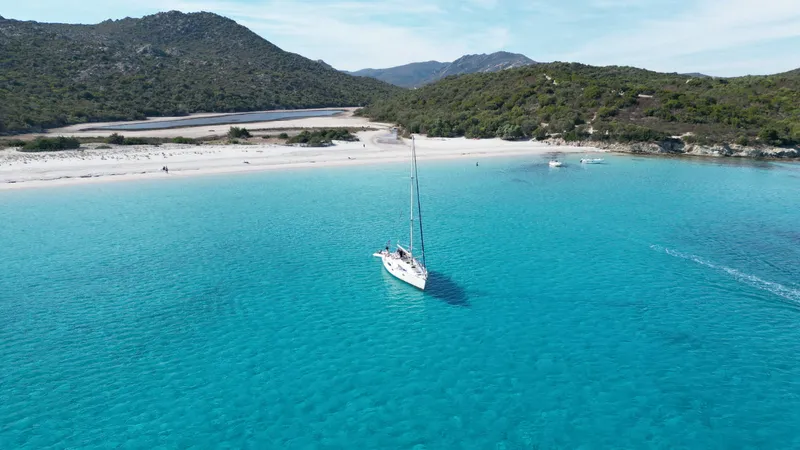
Full day
Cap Corse & Nonza day cruise
A full day to sail up the west coast to Nonza, anchor facing the perched village and lunch on board.
Découvrir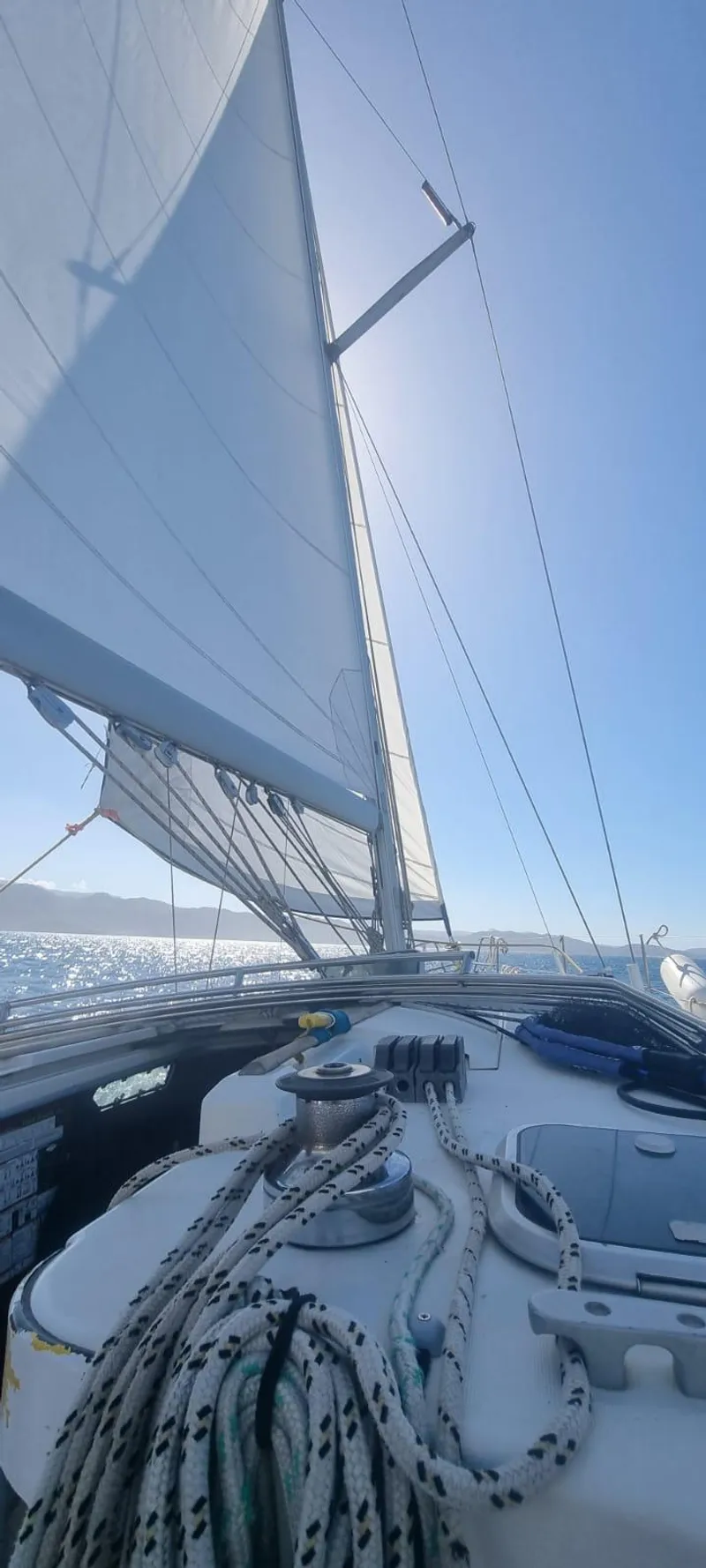
Full day
Agriates day trip
Tower of Mortella, Pigeon Caves, Lotu beach and lunch on board. Our signature cruise.
DécouvrirGlossary of the gulf and Northern Corsica
Glossary Key terms to understand the gulf and Northern Corsica
Key terms to understand the gulf and Northern Corsica
Geography
- Cap Corse
- Rocky peninsula 40 km long and 12 km wide pointing north from Corsica. Shelters some twenty villages and the Finocchiarola islands nature reserve.
- Nebbiu
- Inland micro-region behind Saint-Florent, around the villages of Oletta, Murato and Santo-Pietro-di-Tenda. Known for its Romanesque San Michele church (12th century) in polychrome marble.
- Balagne
- An agricultural region of Northern Corsica west of the Agriates. Its capital is Calvi. Renowned for AOP olive oils, hill villages (Pigna, Sant'Antonino) and its craft tradition.
- Conca d'Oru
- Literally 'golden shell', an agricultural valley between Patrimonio and Saint-Florent. Produces wine, olives and citrus since the Genoese period.
History
- Genoa / Republic of Genoa
- Italian maritime republic that administered Corsica from 1284 to 1768. Left more than 85 Genoese towers on the island and citadels in every major port (Saint-Florent, Calvi, Bonifacio, Ajaccio).
- Pasquale Paoli
- Corsican general and statesman (1725-1807), architect of the brief independent Kingdom of Corsica (1755-1769). Gave the island its first Constitution and founded Corte University. The Paolian towers (like Nonza's) date from this period.
- Genoese tower
- Circular coastal watchtower built by the Genoese between 1530 and 1620 to survey Barbary raids. 10-15 m tall, 4 m wall thickness. 85 examples are recorded; 67 survive today.
- Martello tower
- British coastal defence tower built between 1804 and 1812, inspired by the Tower of Mortella at Saint-Florent. 103 examples erected in England, Ireland, Canada, Jamaica, Australia and South Africa.
Wine
- AOP Patrimonio
- The first Corsican wine Protected Designation of Origin (1968). Covers 9 villages and 420 hectares. Native grape varieties: niellucciu (red), vermentinu (white), muscat petits grains (naturally sweet).
- Niellucciu
- Corsican red grape variety related to Tuscan sangiovese. 80% of Patrimonio red plantings. Produces structured, spicy wines good for ageing (5-10 years).
- Vermentinu / Corsican Malvoisie
- Mediterranean white grape variety (called rolle in Provence, vermentino in Sardinia). Dry, aromatic wines ideal with gulf fish.
- Muscat du Cap Corse AOP
- Naturally sweet wine produced from muscat petits grains in the Cap Corse. Served as aperitif or with brocciu desserts. AOP since 1993.
Sailing
- Libeccio
- Dominant south-westerly wind in Northern Corsica. Hot and dry in summer, can raise a choppy sea in the gulf quickly. Responsible for the finest sunsets on the Cap Corse west coast.
- Mistral
- North-westerly wind, cold and dry. Clears the sky for outstanding visibility but can make the gulf uncomfortable — some sailings are postponed.
- Tramontane
- Northerly wind, cold, often related to the mistral. Sometimes blows for several consecutive days. Rare in summer, common in winter.
Gastronomy
- Brocciu AOP
- Fresh Corsican cheese made from sheep or goat milk, available only from November to June. Base of most traditional Corsican desserts (fiadone, imbrucciata).
- Fiadone
- Corsican cheesecake made with brocciu, lemon zest and brandy. Served warm. A signature dessert of Saint-Florent and all of Corsica.
- Citron
- Ancient citrus of the Cap Corse, used candied, in liqueur, and in biscuits. Commercial production is still maintained at Morsiglia and around Rogliano.
Frequently asked questions
The comparison, born in the 1970s and 1980s with the arrival of leisure yachting, rests on three elements: a lively marina in season facing the village, restaurant terraces perched right on the quay, and a blend of fishermen and yacht owners coexisting without friction. Saint-Florent is nevertheless infinitely quieter than Saint-Tropez — 1,500 inhabitants, no club nights, no luxury brand boutiques. It remains a Corsican village first and foremost.
Nonza for its village perched 100 m above its black-pebble beach and its Paolian tower; Pino for its preserved charm and baroque church; Centuri for its lobster-fishing harbour; Macinaggio for access to the Finocchiarola nature reserve and the old customs path. From the sea, Nonza remains the most spectacular, appearing suddenly as the yacht rounds a headland.
A Genoese tower built in 1563 at the southern point of the Gulf of Saint-Florent, famous for inspiring the British Martello towers. In 1794, a small French garrison held out for three days against an assault by the British fleet under Admiral Nelson. Impressed, the Royal Navy copied the design: 103 Martello towers were built between 1804 and 1812 along English, Irish, Canadian and Australian coasts, their name derived — through mistranscription — from the Corsican Mortella.
The AOP Patrimonio region, Corsica's first wine appellation (1968), extends across 9 villages just inland of Saint-Florent: Patrimonio, Barbaggio, Farinole, Poggio-d'Oletta, Santo-Pietro-di-Tenda, Oletta, Vallecalle, Sorio and Olmeta-di-Tuda. Notable domaines include Antoine Arena (biodynamic), Orenga de Gaffory (historic cellar), Clos Teddi (rosés), Yves Leccia (precision winemaking), Domaine Gentile (old vines), and Jean-Laurent de Bernardi. Most welcome visitors for tastings, often free with booking.
Yes. Three beaches are walkable or a short drive from the village. Roya beach (1.5 km of clear sand west of the harbour, family-friendly) is 10 minutes on foot. Olzo beach (500 m north) is wilder with low vegetation for natural shade. Tettola beach is a better-kept secret: a small sand-and-pebble cove with rocky seabed perfect for snorkelling. For the more iconic Saleccia and Lotu beaches, you'll need to head out to the Agriates.
Three to five nights lets you combine a tour of the village, a Patrimonio wine tasting, a full-day sailing trip to the Agriates and a half-day to Cap Corse. Three nights is the tight version; five allows for a more relaxed pace. Less would leave you frustrated (without having seen Saleccia); more lets you extend into the Balagne (Calvi, Pigna, Sant'Antonino) or the Nebbiu hinterland (Murato and its polychrome marble church).
Saint-Florent is a Genoese village at the mouth of a gulf, 1,500 inhabitants, intimate atmosphere. Calvi is a fortified town in the Balagne, 5,500 inhabitants, more urban in feel with its imposing citadel, larger harbour and livelier nightlife. Saint-Florent opens onto the Agriates desert and the Cap Corse; Calvi onto the Piana calanques and the Balagne. The two complement each other well on a one-week Corsican itinerary.
Three options. By car via the D81: roughly 45 minutes along a winding but spectacular coast road, 23 km of switchbacks. By bicycle: possible for serious cyclists but demanding (substantial cumulative elevation, no bike lane). By boat: 1h30 under sail, with the option of anchoring directly in front of the village — this is the programme of our Cap Corse — Nonza day cruise.
They come from a former asbestos mine, worked above the village from 1948 to 1965. Waste from the mine was discharged into the sea via the cliff, gradually burying the original beach and giving it its distinctive dark colour. The site has since been fully remediated and poses no health risk for bathers — the asbestos is bound into the rock and no longer airborne — but the metallic sheen of the pebbles remains unique in the Mediterranean.
Yes, the marina has 750 berths and accommodates yachts up to 40 metres. The harbour office is open from April to end of October. In peak season (July-August), visitor berths are scarce: book several weeks in advance. Day-cruise departures are from pontoon E, on the village side. Fuel, water, power and Wi-Fi are available.